The Computer Science Career We Prepared For Is Changing
Before you panic lemme explain
AI didn't just change how we code. It quietly changed how companies hire, what skills matter, and who gets left behind.
A few years ago, the path was simple. Learn a language, grind LeetCode, build side projects, land internships.
Yea... it's not the same anymore.
I've been talking with a few seniors and everyone says the current market is not looking good. But me being me, I couldn't just sit there and do nothing. So I dug deeper and came up with strategies to overcome this bad weather.
These are some findings and perspective shifts I picked up along the way. Decided to compile 'em here :D
Plot Twist: There's a Paper For This
There's a research paper that dropped recently, and it really got me thinking.
The AI Layoff Trap, Brett Hemenway Falk & Gerry Tsoukalas
Imagine every company decides to replace 30% of its workforce. Each company individually is winning, costs go down, productivity goes up, shareholders are happy.
But the laid-off workers were also consumers. They were paying for Netflix subscriptions, Swiggy, electronics, e-commerce purchases, ride bookings.
Now imagine every company does this simultaneously. Millions of people lose income. Consumer spending drops. Suddenly a new problem shows up:
"Who is going to buy all the products we're producing? 😭"
This is the economic trap the paper is talking about.
Okay, so you might be thinking: not every company is gonna start laying people off. But here's the thing: if Company A is doing this and making their products cheaper, Company B and Company C can't just stand there looking 💀
They have to do the same, or they fall behind.
So who's gonna save us from this? :( Luckily, the paper also gives us a solution.
The proposed fix? A Pigouvian tax.
The problem: the company gets the rewards, but everyone else absorbs the cost of weaker economic growth. So we introduce something, just like the government did with pollution taxes.
A Pigouvian tax is simply:
A tax designed to make companies pay for the hidden costs they create for society.
The big takeaway from the paper:
"If AI adoption outpaces the economy's ability to create new jobs, society can enter a self-reinforcing economic trap."
Personally, I've been thinking the same thing. Sudden job loss isn't new, it's happened before. The computer revolution came and replaced a ton of manual labor, but it also created a ton of computer jobs.
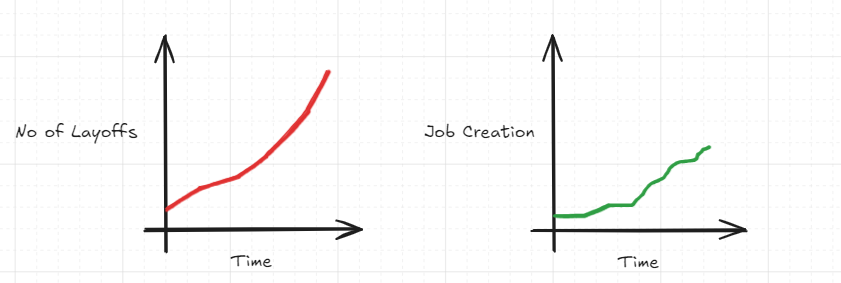
The difference this time? The rate at which AI is replacing jobs isn't being matched by the rate at which new jobs are created. Might be controversial, but yea, that's what I think.
So... what do you even do now?
Aight, AI is changing everything, hiring is weird and layoffs are rising faster than job creation.
“But, what am I gonna do with that information?”
Dw, this is not an article to scare you. I've got something useful for you as well
So I've been thinking about this from a survival perspective and the main question is 'Where is it least risky to be right now?'
Big tech has continued layoffs and restructuring but the media would only show you the bad side. Companies are also hiring aggressively in AI-related roles. It's just that being a generalist software engineer appears riskier than being close to something more specialized.
So a new question arises, "Is joining a startup the new strategy? 🤔"
Startups are looking to grow instead of optimizing. They are hiring for output. So the safest company isn't the biggest company. It's the company that's still expanding
Okay But What's the Move Then
Honestly, a good idea would be joining a startup with proper funding: like seed, Series A, or Series B. Work there, learn a ton of technologies, stack up that experience, and then apply to bigger MNCs. I've seen this work for a good amount of people I know.
Startups throw you into the deep end. You're not just writing code, you're owning stuff end to end. That kind of exposure? MNCs love it later. Plus you build a real portfolio of work.
Also, always try to build a personal brand for yourself and keep putting your work out there. Gives you a real edge when a founder or head of engineering looks at your profile. Let's be honest, no one's gonna read through your resume and believe it word for word, cause it's all a bit exaggerated anyway. But if you build real projects and actually show 'em? You'll definitely get noticed.

One more thing, "Follow the money"
Keep an eye out for global investment trends: which countries are pouring money into tech and infrastructure. That's where the roles will show up.
But does that mean you should pack your bags and leave everything right now? No. The whole point is to play the long game. Build skills where there's room to grow, then cash in when you're ready.
The Big Picture
The main takeaway from all this research and talking with people is that software engineering is splitting into two worlds.
One side is becoming more automated and commoditized. The other side is more valuable because it sits closer to infrastructure and real-world operations.
Choose your side wisely.
That's all for today, Cheers o/